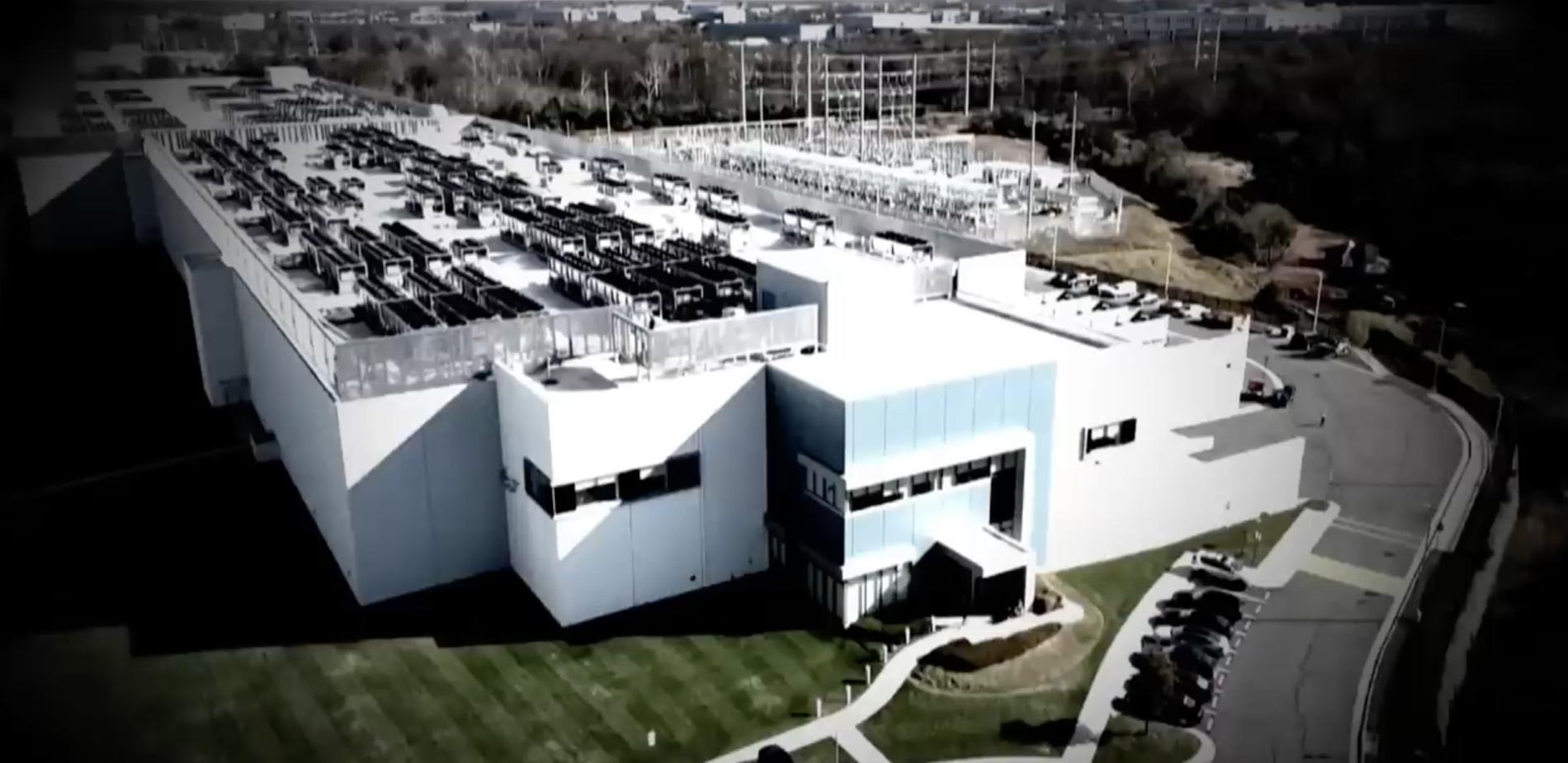
— This isn't the villains' spaceship from a galaxy far, far away. Covering the equivalent of 15 football fields, this is a data center. Without data centers, there would be no Internet — and no artificial intelligence either. And AI is exploding. For example, ChatGPT surpassed one billion users just three years after its launch.
— Its adoption curve is much faster than that of the smartphone, which previously held the record. OpenAI, Google DeepMind, Mistral, Alibaba, xAI and many others are pouring colossal sums into the race for computing power, with the blessing of the countries where they set up operations.
— The AI race is far from over. In fact, we're only at the beginning.
— We're in the race, we're going full throttle, and we're going all the way. A race that is pushing data centers to consume twice as much electricity as they do today by 2030. That's as much as Japan, the world's fifth-largest energy consumer.
— Instead of asking ourselves how we're going to get more computing power, more data centers, the question should be: "How do we do more with less?"
— The scale of the infrastructure being built is completely out of control. A construction boom that is worrying at a time when energy consumption needs to fall to keep greenhouse gas emissions in check. So what kind of climate future lies ahead in the age of data centers? To understand, let's first look at these increasingly massive infrastructures. For a long time, we couldn't see data centers. In fact, the word "cloud" has become associated with digital storage.
— It's as if it were a cloud floating above our heads. Yet 99% of the data that travels does so on land. To store data, to process it, to run ChatGPT — these tools that talk to us and that we interact with — you need very tangible infrastructure that consumes huge amounts of water, metals and electricity, with very real local impacts on the people living nearby. A data center is first and foremost a physical footprint. The larger they are, the greater their computing power. For example, Meta plans to build a facility in Louisiana roughly the size of Manhattan in New York City. Inside that building, there will also be hundreds, thousands, or even hundreds of thousands of servers. These machines are equipped with GPUs, whose processors are increasing their computing capacity. And when that many machines are running at full capacity, they generate heat. Each one has a cooling system, which most often uses water. A lot of water. Google's data centers consumed 23 billion liters of it in 2023. Every component of the building needs to be powered by electricity. In the event of a power outage, a backup system kicks in. It consists of a fuel tank, generators and batteries. Ultimately, a quarter of data centers' carbon footprint is linked solely to their construction. Another impact is the electronic waste they generate.
— The vast majority of it is not recycled. Worldwide, only 20% of electronic waste is handled through organized refurbishment and recycling systems. According to this study, an additional 5 million tons of electronic waste could be generated by 2030. The life cycle of data centers is therefore already highly polluting. And on top of that, we have to add the electricity they will require. Huge amounts of electricity that will need to be available quickly. Behind this frenzy lies AI, and above all, generative AI. From a simple prompt, it can produce videos that are almost too cute to be true, like this one, or bizarre videos like that one. It's difficult for users of generative AI to grasp their carbon footprint.
— We don't know, for Sora or other video generators, how much energy is being used or how many videos are being generated. According to The Shift Project, if data centers' energy needs continue to grow at the current rate, their electricity consumption in Europe will double within five years and triple within ten.
— We are heading in the opposite direction from the one required to meet our climate targets. Greenhouse gas emissions from these infrastructures could increase by 9% a year through 2030. Not only because electricity consumption is rising, but also because the decarbonization of energy production is slowing down. Because data centers require large amounts of stable energy, available immediately, coal-fired power plants are staying open and new gas projects are emerging. Oil giant Exxon is even planning to open a gas-fired power plant specifically to supply data centers.
— The oil and coal industries are feeding off the growth of data centers. And in doing so, we are reviving the oil and gas sector. When we should be doing the opposite and massively reducing coal, gas and oil. If we look at the energy sources that will power data centers over the next ten years, fossil fuels will continue to grow and then level off until at least 2035. This chart also shows that nuclear power will increase its share of the energy mix. A number of AI operators are investing in this low-carbon energy source, which has other drawbacks. Microsoft's Bill Gates has announced plans to restart the Three Mile Island nuclear power plant, site of a major accident in 1979. Another drawback of nuclear power is that it won't meet energy needs for another decade or so. These investments are designed to last.
— The digital industry today looks a lot like the oil industry in the 1980s. People used to say it was the only solution for transportation, that we needed more infrastructure, more extraction, more cars, and so on, and that it was the only possible solution. Our entire socioeconomic system had to revolve around oil. And indeed, 40 years later, decarbonizing transportation and all those industries is extremely difficult. Operators, for their part, tout efficiency gains from their equipment and various projects to reduce their footprint. But shouldn't we instead be asking whether there are other possible uses for AI? Heating swimming pools or homes to a comfortable temperature using the heat generated by data centers is one of the beneficial applications proposed by operators. Google, for instance, is investing €5 billion in Germany. The greenhouse gas savings from these systems remain marginal, and they act as a smokescreen over the question of whether data centers are actually necessary.
— The number one question we should be asking is: "What are they going to be used for? What is the purpose behind building them? Do we need them if we want to stay on a trajectory toward preserving a habitable planet?" That's the question. According to Microsoft's head of sustainability, the answer is yes. For Melanie Nakagawa, AI and the energy transition go hand in hand.
— There are models that are extremely useful in the fight against climate change: new molecules for batteries, climate forecasting, satellite image analysis — there are plenty of them. They are very small models that will often run locally, requiring relatively little data and energy. So there is no need for the colossal data centers that are springing up everywhere. Why this race for computing power?
— We first need to dismantle a myth. These major American providers — always the same ones, Microsoft, Amazon, Meta, joined by OpenAI, Oracle, and others — have managed to convince everyone that the only worthwhile AI is generative AI.
— We could explore different, diverse paradigms, with multiple models, each designed to answer a different question or perform a different task. But no: because of this quest for "super AI," we have taken the path of ever-larger models.
— We are in the midst of growth. Employment and computing are expanding. That's extraordinary. But faced with these ever-larger and more powerful players, how can we make the case for more resource-efficient AI heard?