The extraordinary discovery dates back to 2020. By studying the remains of two babies from the last Ice Age, buried side by side and covered in ochre, with mammoth ivory beads, palaeogeneticists showed that they were two boys, monozygotic twins, or identical twins. The first died at birth, and his grave was reopened by his relatives 50 days later to accommodate the body of his brother, who had also died. Around a hundred graves belonging to Neanderthals and Sapiens who lived in Europe and the Near East between 100,000 and 10,000 years ago have survived. The surprise is that children were just as likely as adults to be given this type of burial, attesting to the affection they received and the place they held among hunter-gatherers.
— What is surprising is that this was not a practice reserved for one particular segment of the population, since we find adults as well as children, including babies and even the elderly, both men and women. What is striking is that the proportion of children is relatively high compared with that of adults. We have children who were born with disabilities or who had suffered an accident or trauma that left them completely dependent, with relatives constantly by their side. Children who were cherished and loved in the Paleolithic, just as they are today, including those with disabilities. Children who were overlooked by prehistoric research for a very long time. So why was that?
— For decades, researchers focused on men. They hunted, knapped flint, and so on. In recent years, there has been growing interest in women. They are emerging from invisibility. We realized that to build a society, you need both men and women. So women emerged from invisibility as researchers began looking at them and at what they did. More recently, the focus has turned to children. In reality, children left traces of their presence, but we simply did not pay attention to them, because for a long time what interested prehistorians was stone tool production, hunting, and not much else. But prehistoric camps were inhabited by men, women and children. That is absolutely obvious. We used to say that children left no traces. In reality, they did, but if you do not look for them, you will not find them, of course. You only find what you look for. And if you look closely, there are in fact traces left by these children. For about the past ten years, a field of childhood archaeology, largely driven by women researchers, has been seeking material evidence of the presence of young Sapiens. Caves are one example: these enclosed environments have preserved traces of children's presence better than open-air habitation sites.
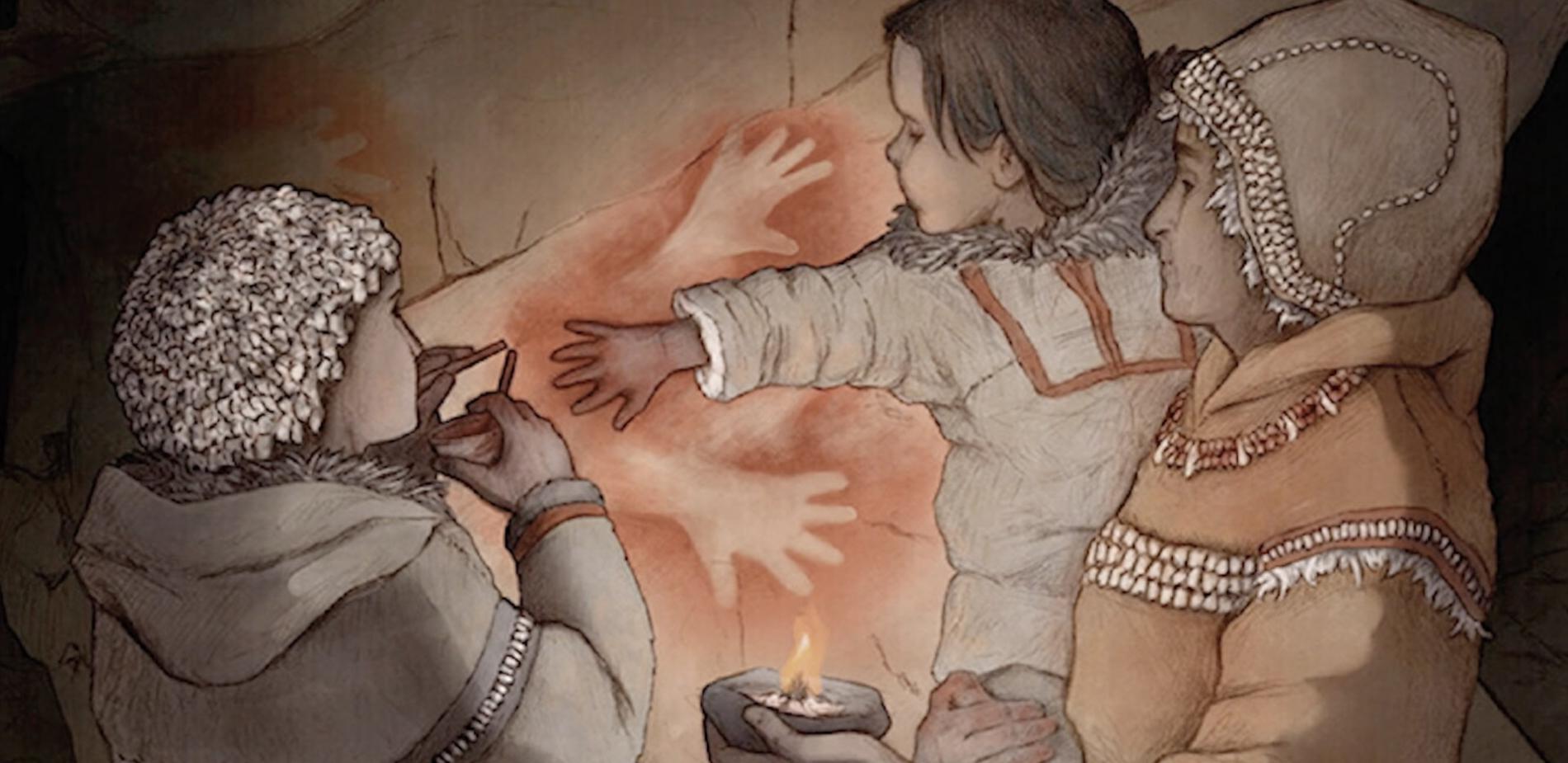
— In caves, we have footprints and negative handprints left on the walls. The footprints are quite remarkable. In some caves, they are abundant when there is clay on the floor, as in some of the caves in the Pyrenees. And more children's footprints have been preserved than adults' footprints. For example, in the Tuc d'Audoubert Cave in Ariège, we have found many children's footprints made by children walking on their heels, perhaps while crouching. The caves were not reserved for adults, whether men or women; families visited them together. We have other examples and evidence of this, which shows that we can forget all those theories that decorated caves were supposedly reserved for shamans and so on. These caves were visited by people of all ages. But what did the children do there?
— All we know is that they placed their hands against the walls, leaving negative handprints, just as adults did, both women and men. Perhaps they played there. We have a remarkable example at Fontanet, in a room that is quite difficult to access, deep inside the cave. There are many different footprints, including children's footprints showing that they lingered and stamped around in certain places, particularly on a ledge, as if they were hiding. And there are balls of clay thrown onto the walls and ceiling. Perhaps these were children passing the time while the adults were busy elsewhere, perhaps decorating the walls. Children were already playful, and constantly learning, as shown by small fingerprints on clay figurines or imperfect flint flakes, evidence that children were learning how to knap flint at the camps. Several small objects have been interpreted as miniature tools, weapons or toys, such as these possible dolls, perhaps decorated and dressed by children. These are all objects with which young Sapiens played, marveled, or learned how to become future hunters and fishermen. The same may be true of objects whose function is still unknown, known as bâtons percés, or perforated batons.
— For the Paleolithic period, we have a few very small objects that could indeed have been toys, used to imitate adults and thus prepare children for their future lives as adults. Perforated batons were made from reindeer antler. Here we have a cast of a perforated baton, exceptionally large in size. They are generally more medium-sized. Here is one that has been carved. It is also a cast. And we have sometimes found very small examples like this one, also decorated with a small head. Either this was an object whose purpose we do not know—a button, perhaps, or an object used to fasten clothing—or it was a very small, miniature perforated baton that children played with. As research progresses, a picture is gradually emerging of societies in which the youngest members were fully integrated, with interactions between generations. Children were numerous and active in the camps.
— In our own society, children are kept apart from adults. From almost the time they are born, they are placed in nurseries, then schools, middle schools and high schools. They have their own particular activities. Whereas in these camps, and in many non-Western societies, things were much more mixed. Adults and children took part in camp life together. You would have heard children's cries and laughter alongside the sounds of technical activities, perhaps the striking of a hammerstone against flint, or the crackling of the fire. So I imagine something very lively, very dynamic, not limited to technical activities. Children who were active and independent from a very young age, as in “traditional” societies.
— In non-industrial societies, children mature much earlier. Women begin having children at 14, rather than at 18 or 20 as in our societies. From a very young age, they have responsibilities and enter adult life much earlier. In Western societies, we keep children and adolescents in the world of childhood for a very long time. It is likely, even though we have no direct evidence, that children and adolescents were active from an early age. More mature and precocious than children in our 21st-century industrial societies, and physically larger too, like all Paleolithic Sapiens compared with people today, these children from the distant past ultimately seem remarkably close to us.
— I feel a certain affection for them because, at the time, some children were cared for and surrounded by others, particularly when they had disabilities. They were buried with ochre and ornaments. We have extraordinary burials, such as those at Sungir, with an enormous number of ornaments and objects accompanying the children. I feel a certain affection for these children, just as their parents must have felt affection for them at the time. We should not forget that these children are our ancestors. Ultimately, we are here because of them.