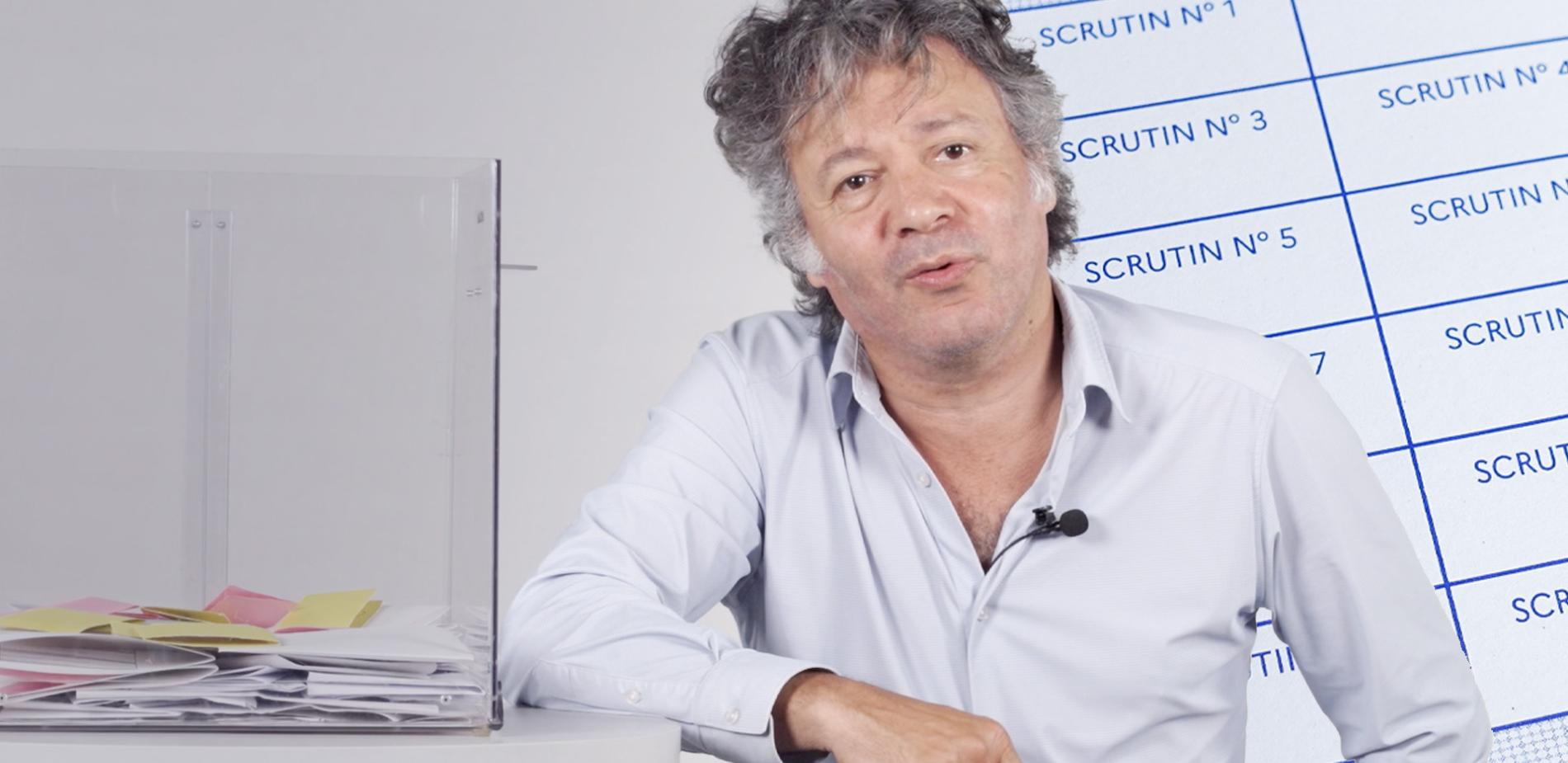
— Why would someone who was elected under a particular system want to change it once they have been elected, when that very system enabled them to win? It is very complicated. It can only be done by citizens. My name is Rida Laraki. Together with Michel Balinski, I co-invented a voting method called majority judgment.
“Majority judgment in 30 seconds.”
Majority judgment asks voters to rate each candidate by selecting one box for each of them. They evaluate every candidate on a scale of grades, which we call a common language, like the grades used in the French baccalaureate: Excellent, Very Good, Good, all the way down to Reject. The candidate with the best evaluation from the majority wins the election.
“Why is the current voting system flawed?”
Well, I am not the first to say so. This voting method was already criticized by several thinkers during the French Revolution. The first flaw is that we limit voters and force them to choose, even though their opinions are much more complex. Sometimes they like three, four or five candidates. They reject three or four others, and they have neither a favorable nor an unfavorable opinion of others. None of this is taken into account.
The second problem is what is known as Arrow's paradox: the presence or absence of a candidate who has no chance of winning can change the outcome of an election, even when voters' opinions remain exactly the same. Take the 2002 election as an example. There were 16 candidates, 11 of whom were on the left. The result was a dispersion of left-wing voters' ballots, which eliminated the left from the second round and led to Jean-Marie Le Pen qualifying for the runoff, where he was defeated by Jacques Chirac, 82% to just over 17%. This clearly shows that the fact that Jean-Marie Le Pen came 0.5 percentage points ahead of Lionel Jospin in the first round was not because he was a better candidate than Lionel Jospin. It was because left-wing voters had scattered their votes among several candidates.
“Majority judgment is too complicated as a system.”
I strongly disagree with that statement. On the contrary, it is much more intuitive and simpler for voters to express their views on all the candidates: “This one, Very Good. This one, Good. This one, Fairly Good. This one, Reject.” ...than to have to choose just one. So the ballot itself is simpler.
The second criticism concerns the counting method. It requires a little mathematics. It is not very complicated. You can do it with simple additions. The system has been used several times. It has been tested. It has been used in schools. It has been used by the CNRS in recruitment committees and by associations. There is an association called Mieux Voter that has a website where you can hold a vote. Every year, more than 10,000 votes are conducted using majority judgment. That clearly shows that the system is not particularly complicated. It can be adopted and used.
In Switzerland, they adopted a system that is extremely complicated to explain. You need a computer to calculate coefficients in a matrix of rows and columns in order to determine the winner. But it was adopted by referendum, by voters, against the wishes of the major political parties, because the system did not favor them. Despite that, the system, known as biproportional apportionment, was adopted. And I would add that it was invented in France. One of its inventors was Michel Balinski, my co-author on majority judgment. All right, I'm going to change color. Let me read the question.
“What do you like most about this quest for the perfect voting system?”
It was the scientific recognition. I never imagined for a second that the system we were developing would ever be used in practice or attract the interest of the general public. What interested me were the names behind it. Arrow, a Nobel laureate; Amartya Sen, a Nobel laureate; Condorcet, a member of the Académie Française; Borda... These are towering figures. Having an intuition that turned out to be correct on a question far removed from my own research field was a wonderful accident of life. Ultimately, it turned out to be one of the best pieces of work of my life, something I will be genuinely proud of and that may outlive me.
“Why would majority judgment be a better system than the other alternatives?”
That is a very good question. It has three important properties. First, it allows voters to express themselves properly through a very detailed grading scale. Second, it avoids Arrow's paradox. And third, among systems that avoid Arrow's paradox, it does the best possible job of countering strategic voting.
This is where a debate arises among researchers, who do not necessarily agree on which properties are important for a voting system to have. No system satisfies all desirable properties. The question is: what is the right compromise among the various properties? I argue that majority judgment provides the best one for political elections. For non-political elections, where there is no problem of strategic voting, it is not the best system. So it depends on the question being asked.
“Can majority judgment be manipulated?”
There is a very famous theorem, the Gibbard-Satterthwaite theorem: “There is no voting system that cannot be manipulated.” So we can forget about that. On the other hand, we can fight manipulation, and practitioners show us the way.
Take diving. At the Olympic Games, seven judges give a score from 0 to 10 for each dive. The highest and lowest scores are discarded. We keep three of the seven scores and add them together. Why? To avoid ties. Majority judgment works in a similar way. We eliminate as many of the highest and lowest grades as possible until one candidate clearly dominates another. That is the principle behind majority judgment. So yes, it can be manipulated, like every voting method, but by design, it is the least manipulable.
Ah, it is good to end with this question. It is chance.
“Why can't we change the voting system in France?”
Why would someone who was elected under a particular system want to change it once they have been elected, when that very system enabled them to win? It is very complicated. It can only be done by citizens.
A constitution, a political system or a voting method is like a technology. Researchers have thought extensively about the technologies that could be used. There are many of them. Majority judgment is one example, but there are many existing systems that researchers know well, even if they disagree with one another.
Citizens now need to say to themselves: “Let's move to another Republic in which we have better rules that will enable us to do better in the world we live in.” It is time to question these rules of the game. They are not set in stone. We simply invented them 70 years ago. De Gaulle came along with Debré and said: “Let's have a two-round system.” That choice was made at a particular point in time. Now we need to think about changing it.
It will come from citizens, schools, the Cité des sciences, and many other places.