Maths for fairer elections
What if changing how we vote led to better voting? Armed with mathematical tools, researchers are designing new voting systems to make every opinion count.
Investigation by Kyrill Nikitine - Published on
An unprecedented electoral crisis
Abstention is rising sharply. In France, it reached 42% in the first round of the March 2026 municipal elections and 28% during the 2022 presidential race. Average turnout for local and parliamentary elections tumbled from 75% to 55% between 1958 and 2022. This trend has been worsening since 1945 — and France is far from alone.
According to the largest study to date, covering 116 democracies across the Americas, Asia and Europe, participation fell from 82% to 65% between 1945 and 2010.
Why is voter turnout falling when the hard-earned right to vote is considered just as ‘inalienable’ as the right to life or liberty? Mathematicians, economists and political scientists are scrutinising electoral systems, which they see as one of the causes of growing disaffection with democracy. They point in particular to the two-round, single-member majoritarian system used in France and many other nations. Under this setup, voters must pick just one candidate to the exclusion of all others. They may reject both second-round candidates equally yet resign themselves to supporting a barrage républicain — casting a defensive vote to uphold the values of the French Republic. With this voting method, ‘tactical voting’ is increasingly squeezing out ‘sincere voting’.
These election experts specialise in ‘social choice theory’, a concept modernised in the 1950s by the Nobel Prize–winning economist Kenneth Arrow (1921–2017). Their goal is to identify voting systems whose methods and outcomes most accurately reflect all individual preferences. And the hope is that changing how citizens vote will inspire more of them to do so.
Pioneers in social choice
In 2001, at the École Polytechnique, CNRS Research Director Michel Balinski (1933–2019) crossed paths with mathematician Rida Laraki (born in 1974). The former Princeton and Yale professor of mathematics and economics invited the young researcher in game theory to work on alternative voting systems. During the 2002 French presidential election, they organised their first large-scale public experiment using ‘approval voting’ — a system that allows voters to cast ballots for multiple candidates. The test inspired them to explore new avenues. Taking a cue from wine experts and their complex and nuanced ranking methods, the pair later incorporated ‘evaluations’ into a multi-candidate voting model.

The search for the electoral Holy Grail
To understand how voting systems behave and to capture as many opinions as possible, social choice researchers rely on ‘axioms’: fundamental logical propositions that serve as building blocks for reasoning. These range from basic truths like ‘1 + 1 = 2’ to rules like ‘if A = B and B = C, then A = C’. Little known though it may be, the science of electoral systems is hardly new: its roots trace all the way back to the Enlightenment.
It was the French mathematician Nicolas de Condorcet (1743–1794) who first exposed the logical flaws of electoral processes, irrespective of political ideology. He showed that no matter the voting method used, arriving at a truly fair outcome is remarkably difficult.
Whenever three or more candidates are on the ballot, the overall winner is not necessarily the person who would beat every other candidate in a head-to-head match-up. This contradiction is known as ‘Condorcet's paradox’.
France’s current system — the two-round, single-member majoritarian vote — is a textbook example. In fact, it can knock Candidate A out in the first round, even if they would have defeated both finalists, B and C, in one-on-one contests. All it takes is for Candidate A to be the second choice of a majority of voters who backed B or C in round one. As a result, A gets knocked out between the first and second rounds, despite being able to defeat both B and C individually.
To eliminate this bias, researchers suggest replacing traditional ballots with grades, scores or rankings assigned to all candidates. By processing these evaluations using axiomatic tools, they are able to build alternative voting systems that are more representative and fairer.
3 Examples of Alternative Voting Systems
Evaluative voting or ‘majority judgement’
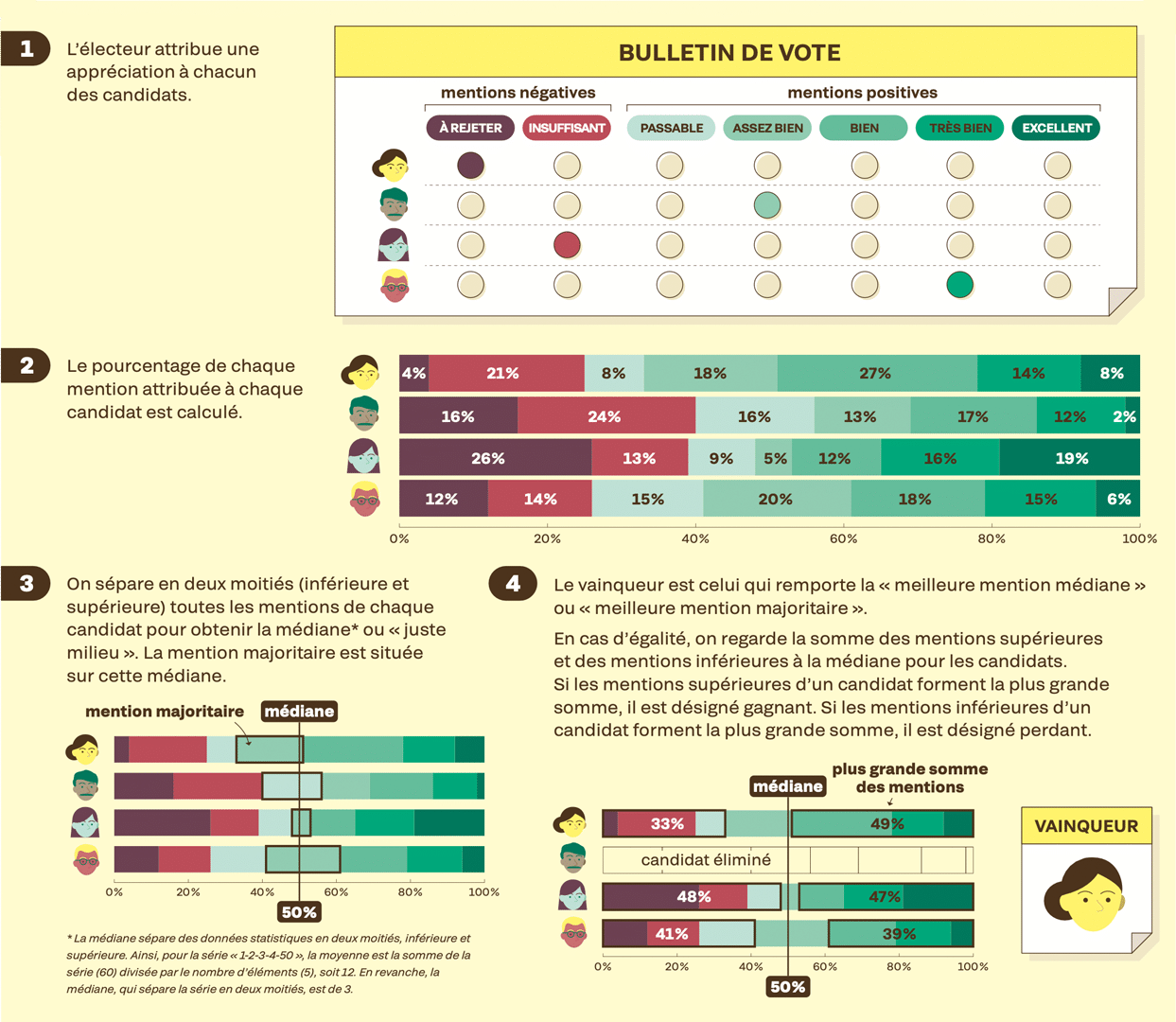
Invented in 2007 by mathematicians Michel Balinski and Rida Laraki, this single-round voting system asks voters to evaluate each candidate using one of seven grades: Reject, Insufficient, Fair, Fairly Good, Good, Very Good or Excellent. It is the first voting system to use natural language for electoral purposes. Each candidate receives a percentage of each grade awarded by all voters.
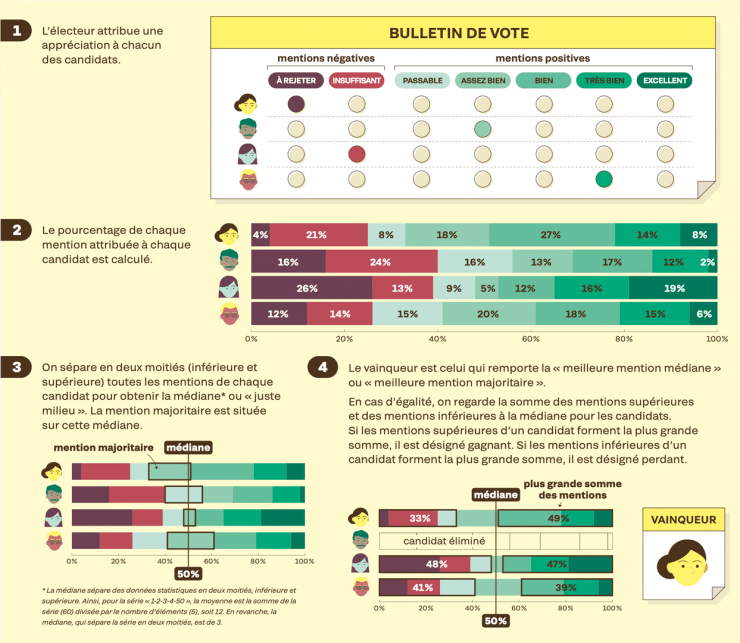
- Voters award a grade to each candidate.
Negative grades: reject or insufficient
Positive grades: fair, fairly good, good, very good or excellent - The percentage for each grade awarded to every candidate is calculated.
- The grades for each candidate are split into lower and upper halves to determine the median* (the middle point). The majority grade sits at this median point.
*The median divides a dataset into two halves, lower and upper. For example, in the set "1–2–3–4–50," the average is the sum (60) divided by the total number of items (5), giving 12. In contrast, the median, which splits the set down the middle, is 3. - The winner is the candidate with the highest median grade (or ‘highest majority grade’). In the event of a tie, the total of grades above and below the median is calculated for each candidate. The candidate with the largest total of grades above the median is declared the winner. Conversely, the candidate with the largest total of grades below the median is declared the loser.
👍 The evaluations have a genuine ‘linguistic meaning’, which brings this voting system close to the spontaneous expression of an opinion, and therefore to the way voters usually relate to candidates.
👎 The median calculation can be hard to grasp; while the ballot itself is straightforward to fill out, the process of determining the winner is more abstract.
Ranked-choice voting or ‘single transferable vote’
Ranked-choice voting was invented around 1860 by British lawyer Thomas Hare and Danish mathematician Carl Andrae. It takes place in a single round. Voters elect candidates by ranking them in order of preference. When a voter's favourite candidate is ranked lowest, the system takes into account their second, third or even fourth choices. These subsequent preferences are transferred to the remaining candidates as the counts progress.
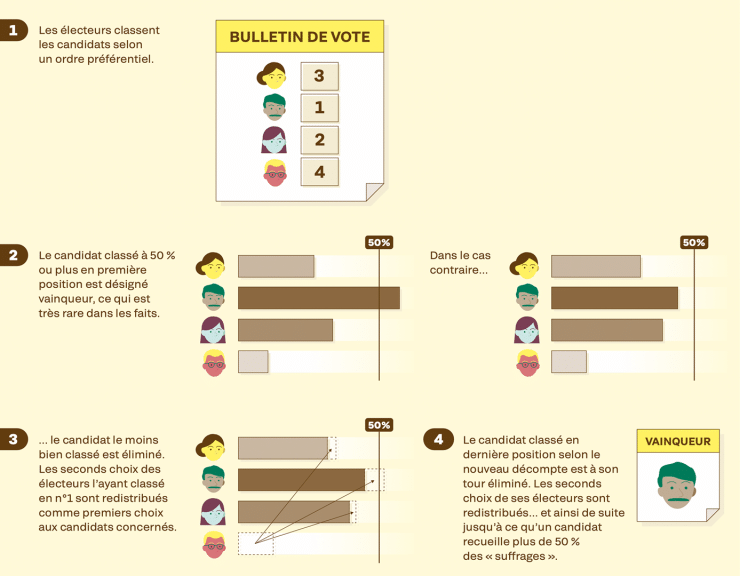
- Voters rank the candidates in order of preference.
Ballot - Any candidate ranked first on 50% or more of the ballots is declared the winner — a rare outcome in practice.
If no candidate reaches this threshold… - … the candidate ranked lowest is eliminated. The second choices on those ballots are then redistributed as first choices to the remaining candidates.
- The candidate now in last place under the updated count is eliminated in turn. Their voters' next choices are redistributed… and the process continues until one candidate secures more than 50% of the votes.
👍 This system encourages voters to support individual candidates rather than vote along party lines, favouring the representation of minority parties and independents.
👎 The counting process is complex, involving multiple rounds to calculate the values of transferred votes, often requiring a dedicated counting facility.
Score voting or ‘scoring’
One of the oldest point-based voting methods dates back to the 13th century, when it was used for centuries to elect the Doge (ruler) of the Republic of Venice. In 1864, it was first used in Greece for parliamentary elections before later being abandoned. How does it work? The ballot features a list of candidates alongside a numerical scale with minimum and maximum values: either strictly positive (0 to 3, 0 to 5, 0 to 9, etc.) or combining positive and negative scores (-1, 0, 1 or -2, -1, 0, 1, 2).
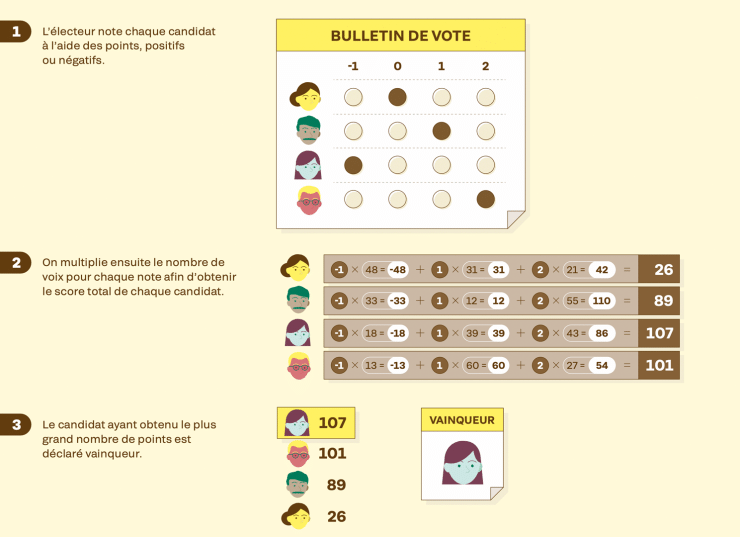
- Voters score each candidate using points, which can be positive or negative.
- The number of votes for each score is then multiplied to calculate every candidate's total score.
- The candidate with the highest total score is declared the winner.
👍 Score voting gives voters a wide expressive range and a straightforward way to influence the outcome: they can use maximum values (such as -5 or +5) to express a ‘strong’ vote. Conversely, a voter who chooses not to use the full range of scores — sticking to 1, 0, or -1, for example — can intentionally reduce the weight of their ballot. This offers an alternative for those who would otherwise cast a blank ballot or abstain in a traditional election.
👎 The subjective value that voters assign to each score varies widely: the same score might be considered ‘fairly good’ by one voter and ‘very average’ by another. Researchers refer to this as the problem of ‘interpersonal comparison’.
Infographics : Julien Tredan-Turini
The power of alternative voting systems
Uninominal voting, also known as single-choice voting, forces electors to pick a single candidate while rejecting every other contender. Alternative voting systems, by contrast, offer a multi-preference approach. By letting voters evaluate every candidate through scores, rankings or grades, these systems capture as many opinions as possible while ranking them. The ultimate goal is to drive down abstention and blank ballots.
Under a ranking system, even if a voter’s top-choice candidate is eliminated, their secondary preferences continue to influence the final result as they are incorporated into the deliberative process.
The aim is to encourage electors to vote sincerely rather than strategically, as with tactical voting.
In a uninominal system, political parties rally behind a single candidate in the hope of making it to the second round. As a result, voters frequently settle for a favourite candidate rather than their first choice. This dynamic effectively squeezes out what researchers call ‘clone’ or ‘minor’ candidates — those whose ideas or personalities are closely linked and who hinder the victory of their own camp. The inclusive design of alternative voting systems, by contrast, increases every candidate’s chances of winning.
Composed of economists and computer scientists from the CNRS (France's national scientific research agency) and several universities, the Voter autrement (‘Voting differently’) research group tested these alternative voting methods on representative population samples during the 2017 and 2022 French presidential elections. In both cases, the outcomes differed radically from the official results, with a marked decline in the results of extreme parties, most notably the Rassemblement National and Reconquête.


An alternative voting system tested in France
France has been experimenting with ‘majority judgement’ for several years. Certain municipalities, including Angers and Paris, have already used this voting method for their deliberations, particularly budgetary ones. By better reflecting voter preferences, researchers observed a marked increase in turnout. Political parties have also adopted the system for internal elections: in 2022, for the Primaire Populaire (‘People's primary’), which drew nearly 400,000 participants and seven candidates; and as early as 2019 by La République en Marche to elect local party leaders. In both instances, voters and organisers welcomed the reduction in tension and conflict between candidates.
An ‘Irish Coffee’ style ballot
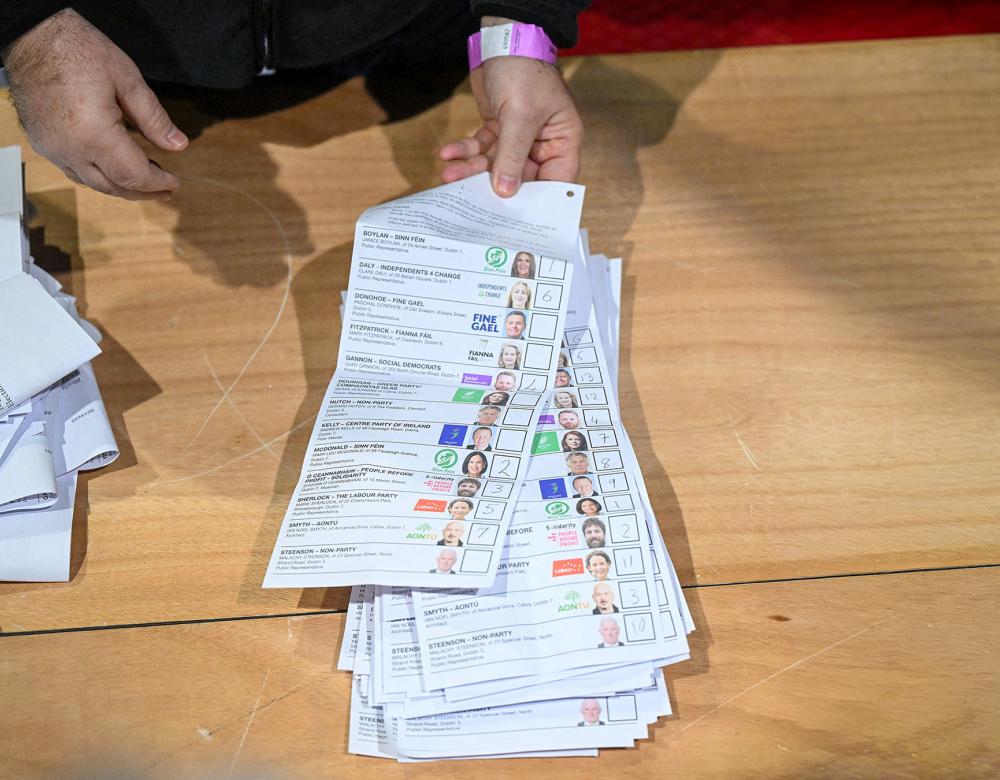
After gaining independence in 1922, the Republic of Ireland was the first country to use an alternative voting system, the ‘single transferable vote’ or ‘instant-runoff voting’, enshrined in its Constitution since 1973. This ranked-choice method asks citizens to order candidates according to their preferences. Voters indicate their top choice by writing a ‘1’ next to the candidate's name on the ballot, and can similarly rank subsequent choices (second, third and so on). On two occasions, the Irish people reaffirmed their commitment to keeping this voting system via referendum.
The inclusive New York model
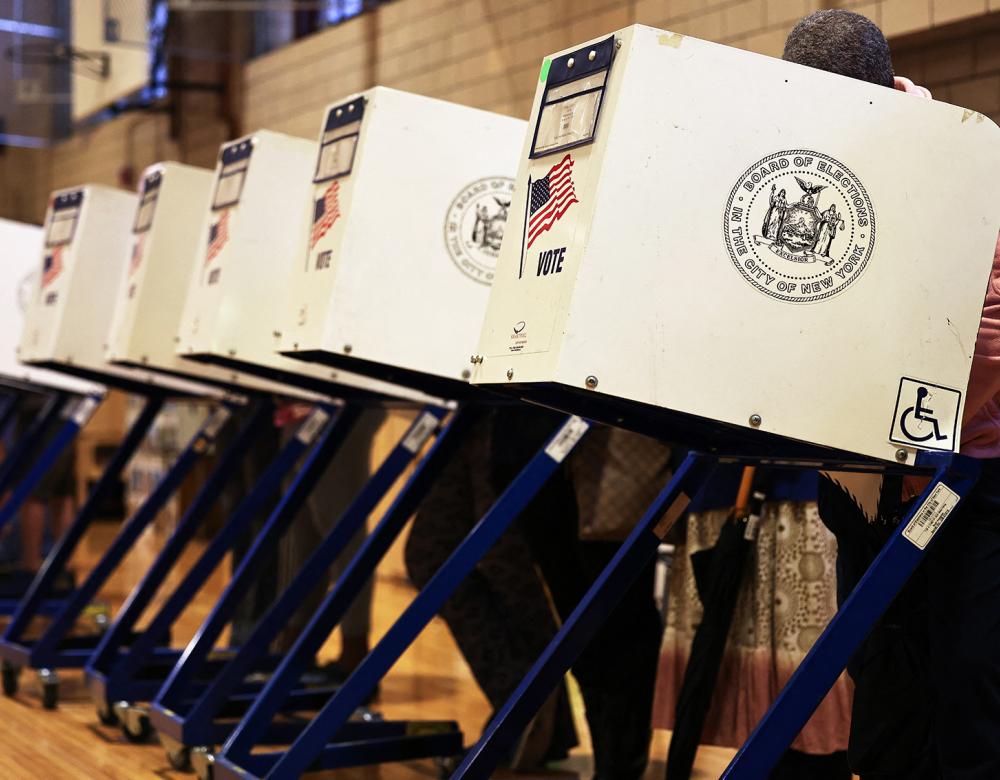
Since 2021, ranked-choice voting (or ‘preference voting’) has been adopted in New York City for primary elections and various municipal offices, including mayor, public advocate, comptroller and borough president. According to several reports, including one by the American voting rights organisation FairVote, this voting method has made elections significantly more inclusive. The 2021 municipal elections featured seven Black candidates, an Orthodox Jewish woman candidate and a Hispanic woman candidate. By 2022, the City Council had a female majority for the first time in its history — 31 out of 51 seats! Among them was the council’s first Muslim woman, representing Brooklyn’s 39th District.
The Swiss puzzle
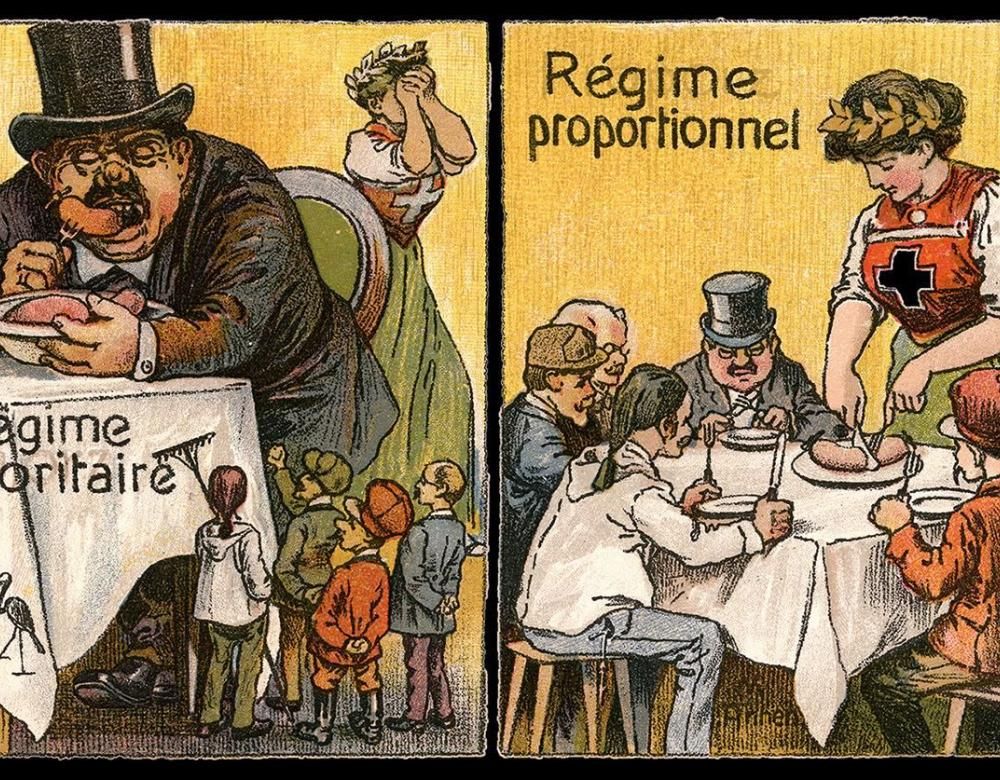
In 2006, Switzerland became the first country in the world to adopt a voting system designed by social choice theorists, led by mathematician Michel Balinski. Known as ‘biproportional apportionment’, this system ensures that every political party receives a number of seats proportional to its vote share, while every region receives a number of seats proportional to its population. Remarkably, it offers the only solution capable of satisfying both proportionality requirements simultaneously! Major parties tried to block the system, but a series of referendums confirmed the public's resolve to keep it, drawn to its electoral fairness and the advantages it offers small parties.
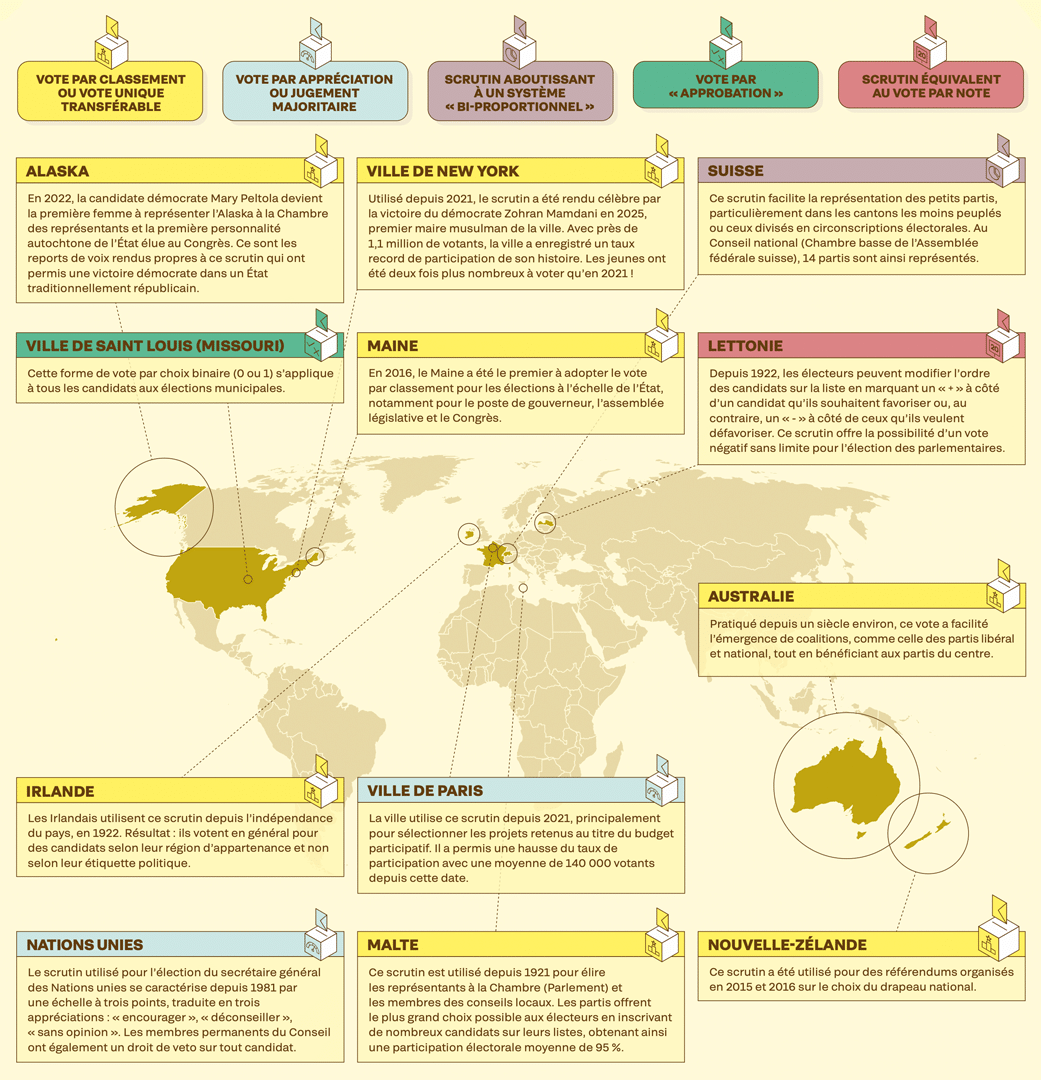
A small atlas of alternative voting systems
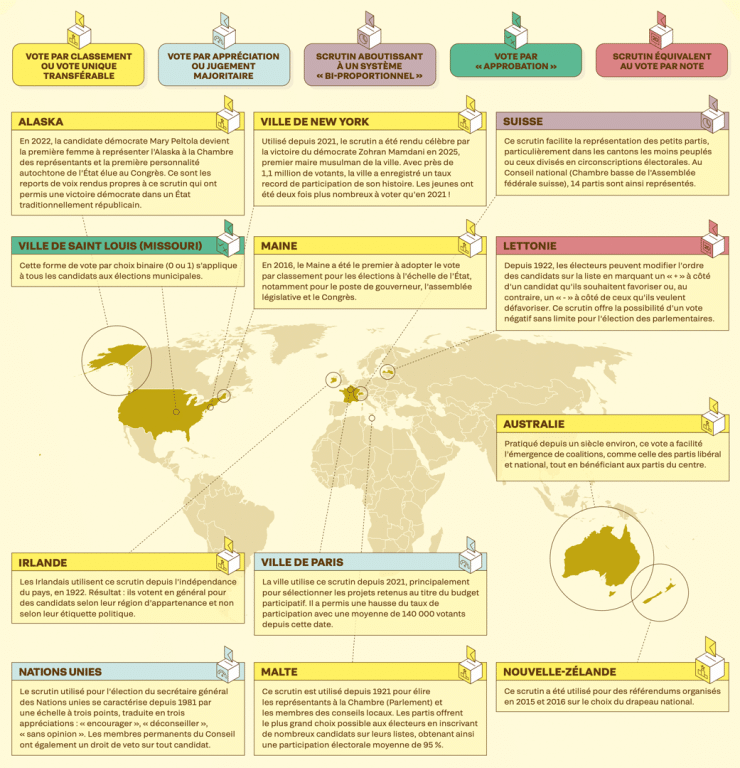
A non-exhaustive overview of the nations, regions and cities that use alternative voting methods.
- Ranked-choice voting or single transferable vote
- Evaluative voting or majority judgement
- Biproportional representation system
- Approval voting
- Score voting (range voting)
Alaska
In 2022, Democrat Mary Peltola became the first woman to represent Alaska in the House of Representatives and the first Indigenous person from the state elected to Congress. It was the transfer of votes under this system that ultimately delivered a Democratic victory in a traditionally Republican stronghold.
City of New York
In use since 2021, the system was thrust into the spotlight by the 2025 victory of Democrat Zohran Mamdani, the city's first Muslim mayor. With nearly 1.1 million ballots cast, the city registered a record turnout. Twice as many young people voted as in 2021!
Switzerland
This voting system facilitates the representation of smaller parties, particularly in less populous cantons or those divided into constituencies. As a result, 14 political parties are represented in the National Council (the lower house of the Swiss Federal Assembly).
City of St. Louis, Missouri
This binary choice method of voting (0 or 1) — known as approval voting — applies to all candidates in municipal elections.
Maine
In 2016, Maine became the first state to adopt ranked-choice voting for statewide elections, including races for governor, the state legislature and Congress.
Latvia
Since 1922, voters have been able to alter the order of candidates on a party list by adding a "+" next to candidates they wish to support, or a "−" next to those they want to penalise. This system allows voters to cast negative votes without limit in parliamentary elections.
Australia
Used for over a century, this system facilitated the emergence of key political alliances — most notably between the Liberal and National parties — while benefiting centrist parties.
Ireland
The Irish have used this voting system since gaining independence in 1922. As a result, voters generally choose candidates based on their local region rather than their party affiliation.
Paris, France
The city has used this voting system since 2021, primarily to select projects for its participatory budget. It has boosted turnout, averaging 140,000 voters per election cycle since then.
United Nations
The voting method used to elect the United Nations Secretary-General has featured, since 1981, a three-point scale translated into three evaluations: ‘encourage’, ‘discourage’ and ‘no opinion’. Permanent members of the Security Council also hold a right of veto over any candidate.
Malta
This voting system has been used since 1921 to elect representatives to Parliament (House of Representatives) and members of local councils. Parties offer voters the widest possible choice by fielding numerous candidates on their lists, with an average turnout of 95%.
New Zealand
This voting system was used for the 2015 and 2016 national flag referendums.